
Picture the scene. A performance of West Side Story at the Birmingham Hippodrome has just finished, and a group of Sondheim Society members are making their way over to our director, Rupert Hands. Between them, they've seen hundreds of productions of this show. Rupert was bracing himself for a polite "it's lovely, but it's not West Side Story".
Instead, they told him it was like seeing West Side Story for the very first time.
We couldn't stop thinking about that. So for this episode of the Open House Podcast, David and our co-host Millie caught up with three of the brilliant creatives behind this summer's production: Rupert, choreographer George Beet, and Latin cultural consultant and intimacy coordinator Andrea Pelaez, who dialled in all the way from sunny Colombia.
Grab a cuppa. Here's a taste of what they had to say, and the full episode is waiting for you at the bottom.
Ask anyone in theatre about their first West Side Story and there's a good chance the film comes up. Rupert admits it's "probably a boring answer", but the film and the cast recording were his way in too.
For George, it was being about ten years old, a lad from up north who loved to dance, watching those guys on screen and realising that dancing could look this cool. Andrea was around the same age in Colombia. She picked it out on a family film night, then spent ages re-enacting the choreography (and the fights) with her older brother. We have a feeling a few of you had your own living-room rumbles growing up.
When Rupert started planning the production, the first thing he wanted to tackle was what he calls "baggage". Classics collect a lot of it over the years: every brilliant past production, and every expectation of what the show is supposed to look like.
He made a great point. Set Shakespeare or Chekhov during the First World War and nobody bats an eyelid. Musicals, though, often get stuck, with revivals that are basically remounts of something that came before. And yet the original West Side Story was wildly experimental. If someone pitched you "gangs in New York who fight by dancing" today, would you jump at it?
"We owe it to the piece and to audiences to be as inventive as the original production was, in our own way."
So the team didn't change a single word of the script, and the story stayed firmly in its original period. But everything you saw felt like now. Designer Libby Todd created a stark white box with two white staircases and projected text marking each location. The Jets were in red, the Sharks in blue, and anyone who'd stepped outside the turf war, or hadn't entered it yet, was in white. Then, in the final moments, the whole company peeled off their coloured hoodies to reveal white vests underneath. Goosebumps.
Rupert said that at times it felt more like a gig than a musical. Honestly? We know exactly what he means.
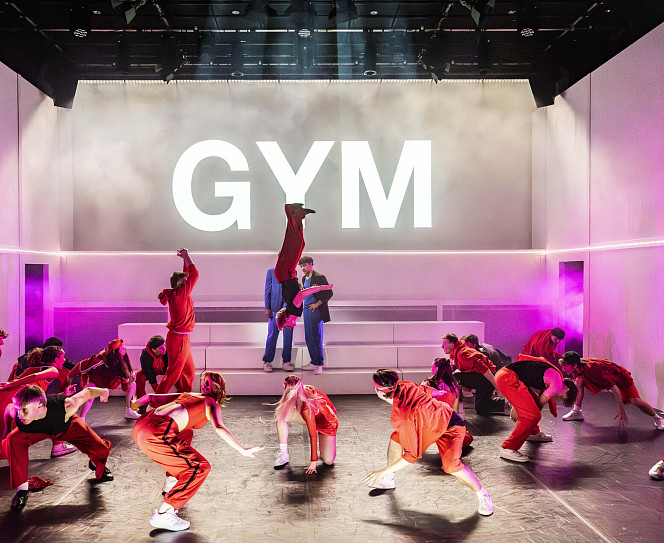
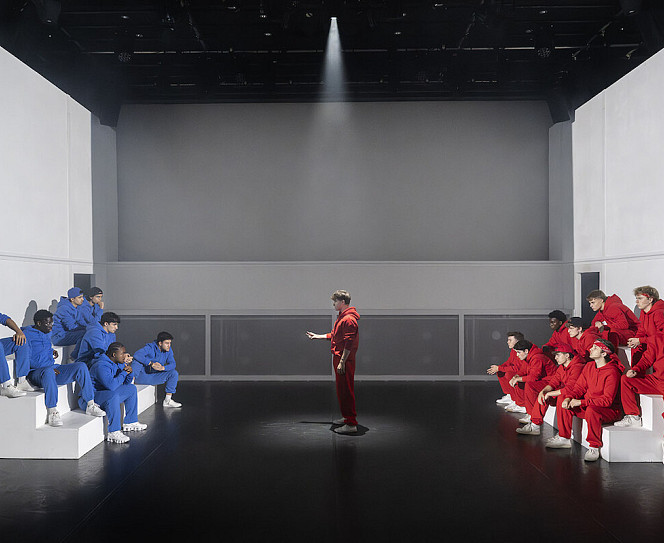
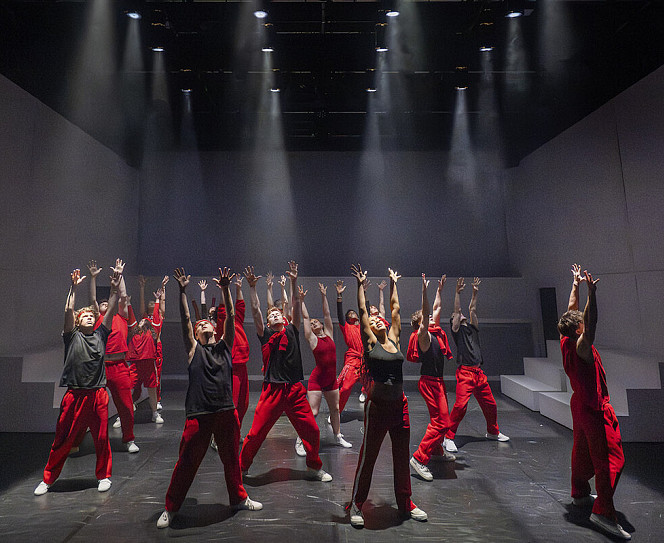
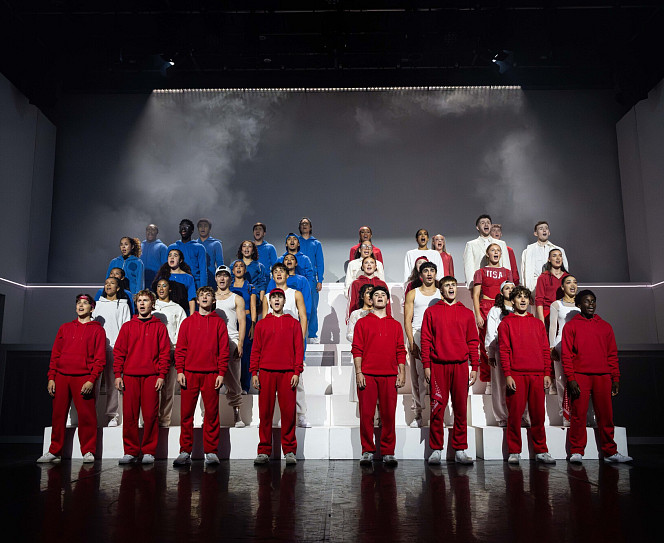
George's reaction to being asked to choreograph West Side Story? "A no-brainer." Not many choreographers get to say they've done it. Mind you, the dust had barely settled on Crazy for You with Rupert, and he joked that he doesn't get it easy with these shows.
He really didn't. Every major dance number had to come together in about two weeks of rehearsal. The trick, he told us, was honouring that iconic style while still making it his own.
"As much as I adore what's been done before, it's been done before. You have to really think outside the box."
Does a choreographer's brain ever switch off? Not George's. He teaches 10 open classes a week at Pineapple Dance Studios, and he reckons his Spotify is "the stagiest thing you've probably ever seen".
One thing that worked in his favour was that this cast were playing their own age. In professional productions, actors are often ageing down. Our company simply brought themselves into the room, with all the energy, anger and love the story needs. That didn't mean George went easy on them, though.
"I never go easy. I treated them like a professional company, but what they brought was almost more exciting, because every one of them was in love with the piece."
As Rupert put it, these are young people giving up their summer holidays to dance those numbers, and in a heatwave, no less. That kind of passion is impossible to fake.
When Millie asked George for his favourite number, he said it was like asking a parent to pick a favourite child. Then, with a little nudge from Rupert, he landed on "Gee, Officer Krupke". It became a full-on tap number lit by torches, and in George's words, the boys "smashed it out of the park".
This year, National Youth Music Theatre very nearly became the International Youth Music Theatre. Three young performers flew over from Colombia to join the company, and Andrea was the one who helped make it happen. Back home, the news caused such a buzz that she ended up doing interviews with a national TV channel.
"It was a dream to build that bridge between Colombia and the UK, my two favourite places in the world."
Andrea also shared a story we'd never heard before. In 2006, a Spanish-language West Side Story was staged in Colombia, and quite by chance, Tom Hatcher, partner of the show's writer Arthur Laurents, saw it. He was so taken with it that he went home and told Laurents all about it, and that conversation went on to shape a Broadway revival that brought Spanish into the show. Not bad for a chance visit!
In the rehearsal room, Andrea helped the cast find what felt real. Rupert described her stepping into a scene to show how people greet each other or walk into a room. It brought a warmth and openness to the Sharks that sat in sharp contrast to the fear running through the Jets.
She was also our intimacy coordinator, something she's been doing for 20 years, including work with young actors on Netflix's One Hundred Years of Solitude. For Andrea, it's all about creating a space where everyone knows their limits and feels safe to explore. She's very clear that she isn't there to be "the police". It's a collaboration.
"We don't need to wait 20 years to prepare the next generation. It was a celebration of different cultures, all together with one goal."
Underneath the music and the dancing, West Side Story deals with some heavy stuff: male aggression, prejudice, and young men desperate to belong to a group that tells them who they are. Rupert pointed out how close that feels to today, with so many young men being pulled towards spaces that tell them bad behaviour is fine. It's a big part of why our company connected with the show so strongly.
We ended with some quickfire questions, starting with one word to sum up the show. Andrea went with "fuego", George said "innovative", Millie said "mesmerising", and Rupert, who asked to go last because he needed more time, chose "unique". We also asked what they'd question about the show. George's answer? How the whole thing happens in about 24 hours. They really did fall hard and fast.
Which brings us back to that Sondheim Society moment. When Millie asked Rupert for one word to describe the whole process, he chose "new".
"How often have you loved something and wished you could experience it again for the very first time? To give people that with a classic show was one of the most rewarding parts of this production."
As David said while wrapping up the episode, the challenge with a classic isn't deciding whether to change it. It's working out what it still has to say, and letting a new generation find their own way in.
There's so much more in the full chat, from how a director and choreographer bounce ideas off each other to what intimacy coordination really looks like in a youth company. Pop your headphones in and enjoy.
